
The outcome is beyond the market's expectation and will be a sentimental boost, say analysts.
S&P BSE Midcap shed 0.8% while S&P BSE Smallcap tumbled 0.6%
.jpg)
UBS said it remained bullish on India and it may be early to book profits.

Omkeshwar Singh, head, Rank MF, a mutual fund investment platform, answers your queries.

Global funds, according to Christopher Wood, global head of equity strategy at Jefferies, are now beginning to pay more attention to India with the market now offering 30 companies with a market capitalisation over $25 billion.

'This looks like a long-term bear market and there could be mounting losses in the near-term,' says Devangshu Datta.
In the broader market, the S&P BSE Midcap ended 0.1% down, while the S&P BSE Smallcap index gained 0.3%.

Omkeshwar Singh, Head, Rank MF, a mutual fund investment platform, answers your queries.

Top gainers in the Sensex pack included Vedanta, ICICI Bank, ONGC, Kotak Bank, Axis Bank, SBI, M&M, Infosys, PowerGrid, HCL Tech, NTPC, Bajaj Finance and Reliance Industries, rising up to 2.72 per cent.

ICICI Bank was the top gainer in the Sensex pack, rising around 4 per cent, followed by UltraTech Cement, Sun Pharma, Bharti Airtel, HUL, SBI, L&T, Axis Bank and IndusInd Bank. On the other hand, Reliance Industries, Bajaj Finserv, HCL Tech and HDFC were among the laggards.

The S&P BSE Midcap and S&P BSE Smallcap indices hit a new lifetime high

Economic growth, which we are taking for granted, slows for a completely different set of local or global factors and the Modi premium vanishes, observes Debashis Basu.

The focus is on corporate results at one level but global news will also have an impact

Kotak Bank was the top loser in the Sensex pack, falling around 3 per cent, followed by Axis Bank, Sun Pharma, HDFC Bank, Bajaj Finance and Asian Paints. On the other hand, ONGC, PowerGrid and IndusInd Bank were the gainers.

From the Sensex pack, NTPC, Bajaj Finance, IndusInd Bank, UltraTech Cement, Bajaj Finserv, State Bank of India, Tata Motors, ITC, Power Grid and Larsen & Toubro were the biggest gainers. IndusInd Bank climbed 2 per cent after the company on Tuesday reported a 30 per cent jump in consolidated net profit in April-June quarter at Rs 2,124.50 crore, helped by core income growth and lower bad loan provisions.

Fiscal pressure for the Indian economy is gradually rising, suggested analysts at Jefferies in a recent note, as oil prices (Brent) - which are close to the $100 a barrel mark - continue to climb ahead of a busy election calendar. They added that the sharp rally in the equity markets during the last few months has made valuations costly. As a result, Jefferies expects the Indian markets to remain choppy in the near term.

The rally in the broader market also mirrored the positive trend seen in other Asian markets.

The National Stock Exchange benchmark index Nifty is likely to remain between 5,050 and 6,100 in the next 12 months, because of lack of triggers in the domestic macro-economic environment and uncertainty in the global markets, a report says.

The combined market capitalisation of the 21 listed PSU banks declined by about Rs 76,000 crore to Rs 425,800 crore during the month.

He said cheap valuations, improving sentiment and the ongoing reform momentum coupled with increased transparency due to the internet are driving investors to the Dalal Street.

Omkeshwar Singh, Head, Rank MF, a mutual fund investment platform, answers your queries.

Broader market outperformed with the S&P BSE Midcap index adding 0.7%, while S&P BSE Smallcap index gained 0.6%.

The finance minister did very well for equity market investors but not so with families, reveals Mahesh Vyas.

Since we are at the start of the month and the quarter, we shall look at the broader picture for the markets.

'Business families like the Godrej group are increasingly realising that an amicable settlement is better.' 'Else, the wealth of all shareholders gets destroyed.'

'Internet, healthcare and life insurance are a few sectors which offer solid long-term decadal potential.'

'We are cautious only on sub-sectors that have seen massive melt-up during the past six months.'

'Investors with higher risk appetite and longer horizon (more than one year) can invest in longer-duration funds like corporate bond funds, long-duration funds and gilt funds for maximum gain.'

Large moves in equity and in currency are expected during March settlement.

Among top losers that dragged down key indices were Infosys, TCS, Reliance, SBI, Tata Steel and ITC, falling up to 2.15 per cent.

After making its entry into the Bombay Stock Exchange's benchmark 30-share index Sensex in May

'The market position from here on is expected to go up'.

'Markets are not expensive; they are fairly priced.'

IT major Accenture's second straight cut in its revenue growth forecast for FY23 suggests there is more pain ahead for the Indian IT sector, say analysts. Accenture has lowered the top end of its FY23 growth guidance in constant currency (CC) to 9 per cent from 10 per cent earlier. The firm, which follows a September-August fiscal cycle, expects a 2-6 per cent CC growth in Q4 of FY23 (June-August 2023) versus the 6-10 per cent prior guidance.

The markets will remain choppy ahead of RBI policy.

All Sensex components ended in the red. SBI was the top loser, followed by ONGC, Axis Bank, ITC, Titan, Bajaj Auto, TCS and IndusInd Bank.
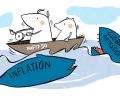
'...over the long-term can be done only by investing in equities.' 'And during weak macros, one needs t1o allocate more than drawing it down, because they offer the best entry point.'

While the corporate sector has benefited from massive capital expenditure, leading to sky-rocketing stock prices, investors would do well to keep an eye on the macroeconomic picture and government finances, not just corporate profits, for signs of trouble, alerts Debashis Basu.

The challenge isn't in selling -- it's easy to sell when the market peaks. The real challenge is in buying back.

Government-owned companies are more generous in rewarding their shareholders with dividends.
